


Canada's Security Camera Laws 2026: Where Can You Legally Point Your Cameras?
In 2026, the line between home security and illegal surveillance has never been thinner. As high-definition 4K cameras and AI-driven monitoring become standard in Canadian neighborhoods, homeowners are increasingly finding themselves at the center of privacy disputes and legal challenges.
Protecting your property is a right, but it is not absolute. Under Canadian law, your right to security must be balanced against your neighbor's "Reasonable Expectation of Privacy." This guide breaks down the federal and provincial regulations you must follow to ensure your system remains a protective asset, not a legal liability.
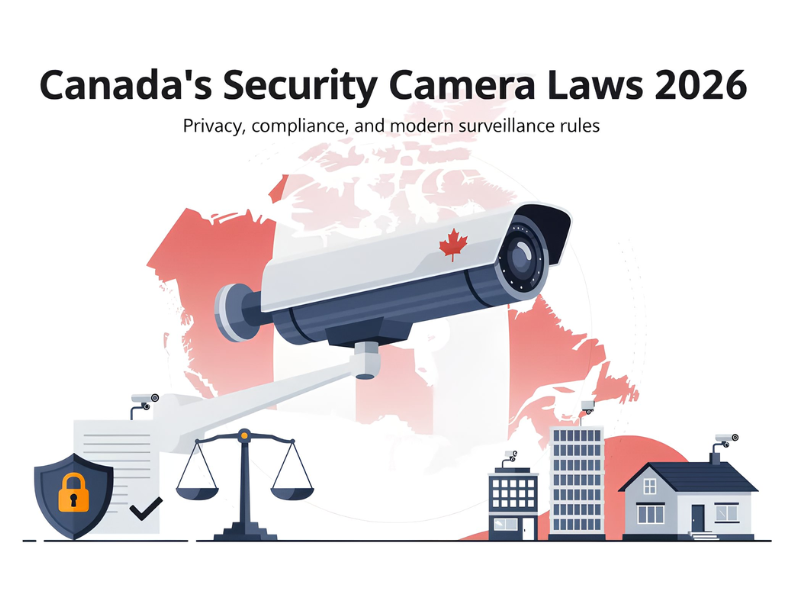
The Legal Landscape: PIPEDA and the Criminal Code
Surveillance in Canada is governed by a framework of federal and provincial statutes. While the Privacy Act covers government entities, private citizens and businesses generally fall under PIPEDA (Personal Information Protection and Electronic Documents Act) and the Criminal Code of Canada.
1. The "Intrusion upon Seclusion" Tort
If your security camera is positioned to capture a neighbor's backyard or look directly into their windows, you may be liable for a civil tort known as "Intrusion upon Seclusion." Canadian courts have ruled that individuals have a right to lead their lives free from constant scrutiny in areas where privacy is expected.
2. Residential Boundaries: What You Can Record
Generally, you are legally permitted to record:
What You CAN Record
- Your Own Property: Driveways, front doors, and perimeters
- Incidental Public Space: Capturing a portion of the sidewalk or street is usually acceptable, provided the camera is not "targeting" passersby
The No-Go Zones
You must avoid pointing cameras at neighbor's windows, fenced-in backyards, or any area where a person would reasonably expect to be unobserved (such as a swimming pool or hot tub area).
Audio Recording: A Federal Offence Risk
Perhaps the most misunderstood aspect of Canadian security law is audio. Under Section 184 of the Criminal Code, it is illegal to willfully intercept a private communication.
Unlike video, which is often viewed as "overt" surveillance, audio recording is strictly regulated. If your camera records a private conversation on the sidewalk or in a neighbor's yard without the consent of at least one participant, you could technically face criminal charges.
Recommendation
For 2026 compliance, always disable the microphone feature on cameras facing public or shared spaces.
The 2026 AI Gap: Human Detection vs. Facial Recognition
Most existing guides focus on where the lens is pointed, but in 2026, the law is increasingly focused on what the software is doing.
AI Technology Compliance
- Human/Vehicle Detection (Compliant): This technology identifies a "shape" to reduce false alarms. Since it does not store unique identity data, it is generally considered privacy-safe
- Facial Recognition (High Risk): Under the latest 2026 amendments to the Digital Charter Implementation Act, the collection of biometric data (faces) without explicit consent is a major red flag. If your system identifies and stores the names or "face prints" of neighbors or strangers walking by, you are likely in violation of modern privacy standards
Best Practices for a Compliant Installation
To ensure your camera security system meets all 2026 Canadian standards, we recommend three key steps:
Compliance Checklist
- Privacy Masking: Use your camera's software to "black out" neighbor's windows or property lines that appear in the frame
- Visible Signage: Post clear "Video Surveillance" signs. This legally lowers the expectation of privacy for anyone entering your property
- Proportionality: Ensure the surveillance is proportionate to the risk. A 24/7 high-zoom camera aimed at a neighbor's door to watch for packages is rarely seen as proportionate by Canadian courts
Protect Your Home Legally in 2026
The legal landscape of home security in 2026 is complex, but protecting your Canadian home doesn't have to be a legal risk. By balancing high-tech surveillance with respect for your neighbor's privacy, you can enjoy peace of mind without the threat of a lawsuit.
Don't leave your compliance to chance — trust the experts at Alarm Dealer to design a privacy-first system tailored to your property.